

302nd Birthday of Immanuel Kant
Bean Speech, April 22, 2026, Berlin
Dr. Mahmut Kuyumcu
Distinguished guests, ladies and gentlemen, dear friends,
the title of my “Bean Speech” is: The Four Sages of the World: Socrates, Buddha, Confucius, and Kant. Since I do not come from the Far East, but from Southeastern Anatolia, Upper Mesopotamia, please allow me a few words about my choice of topic:
Although I heard Immanuel Kant’s name mentioned in a general studies course about 60 years ago, I hardly ever engaged with his writings afterward. However, from time to time I read something about the world views of Buddha and Laozi, and occasionally Confucius.
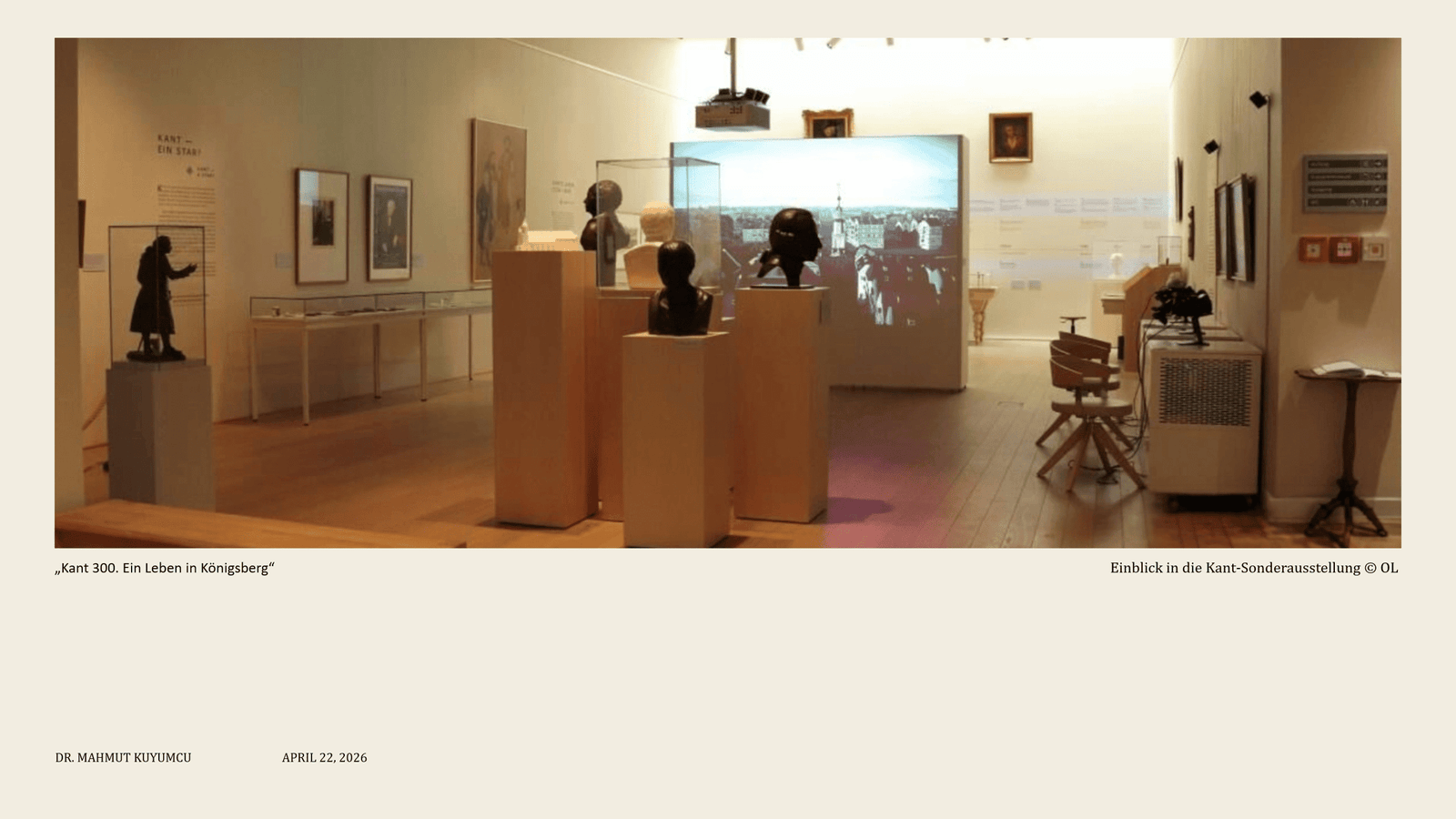
Looking back, I realize the foundation for this topic was laid in August 2024. At that time, I had the opportunity to participate as a guest in our society’s excursion to Lüneburg to visit the special exhibition at the East Prussian State Museum marking Kant’s 300th birthday. Under the direction of the curator Dr Tim Kunze – who is with us this evening – Kant’s personal belongings and significant cultural artefacts of his time had been presented in an impressive manner. Here you can see a photo from one of the exhibition rooms.
When I saw a picture on the wall there, I was electrified:
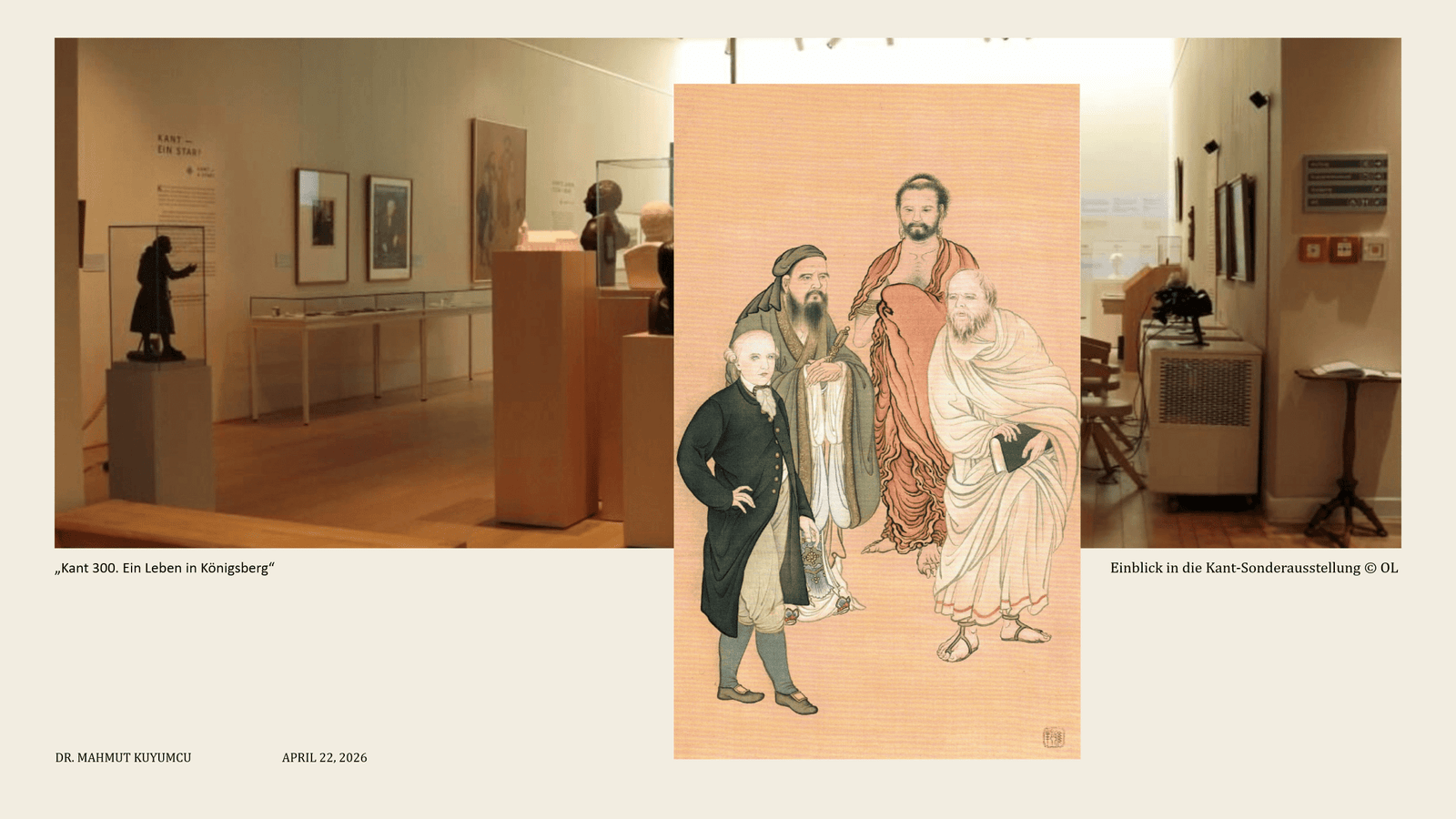
the four figures could be clearly identified from their characteristic depictions – Socrates, Buddha, Confucius and Kant!
As is well known, these three ancient giants have shaped human thinking for over two millennia. Yet the message of this picture was: in the period that followed, only Immanuel Kant is worthy of this rank! The work was obviously of East Asian origin and of an earlier date. But there, as can be seen here
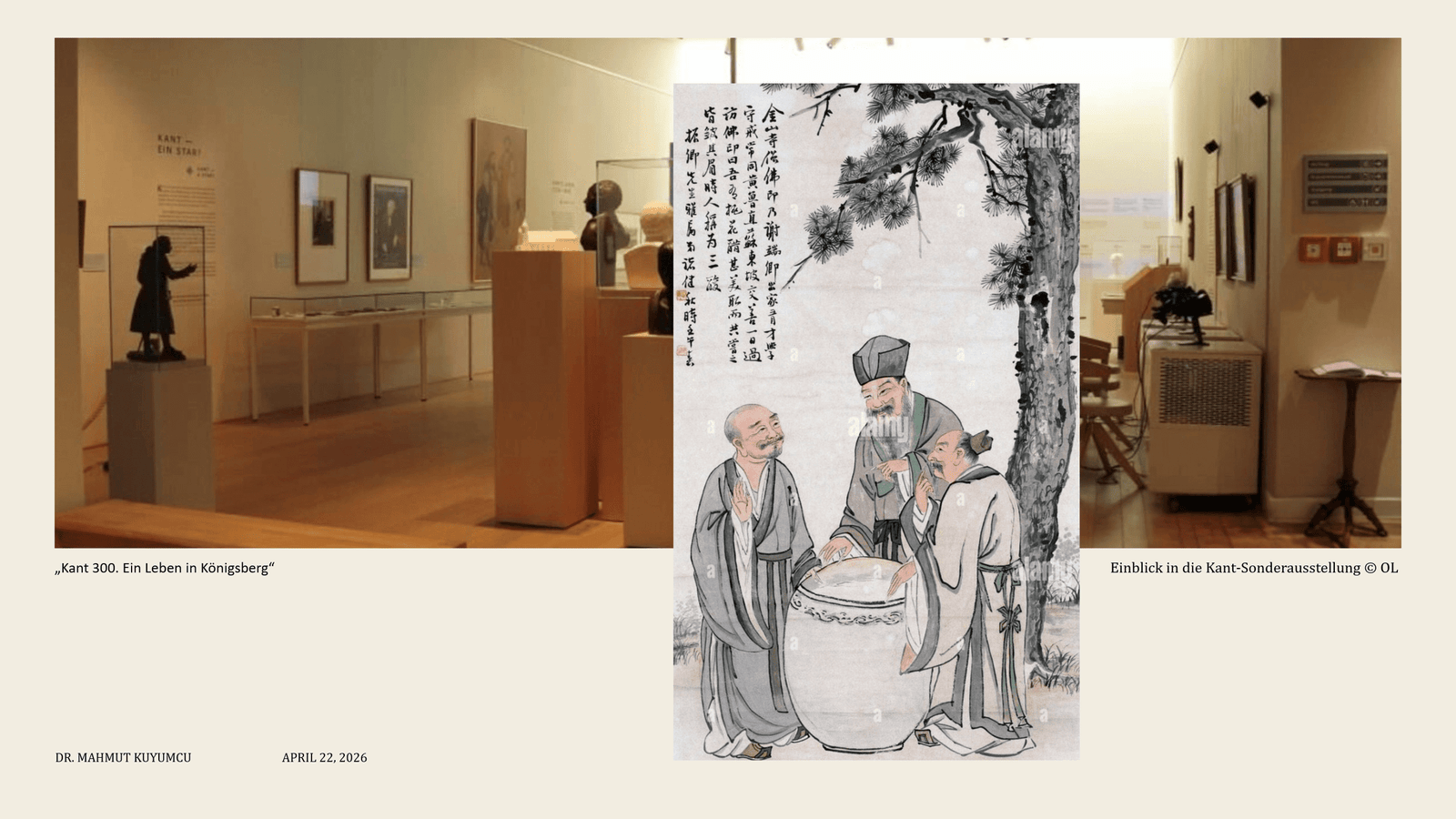
or here,
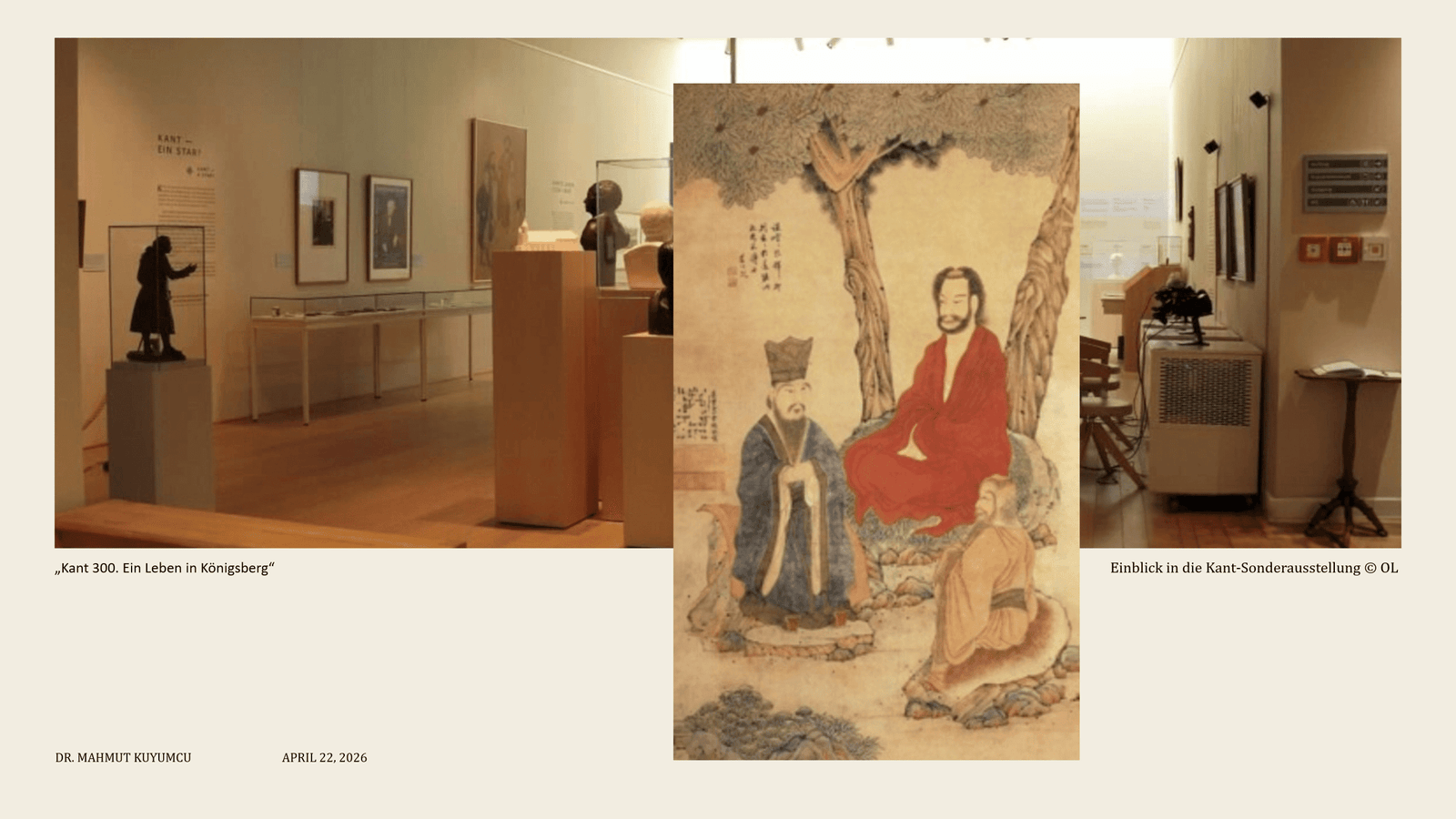
only Buddha, Confucius and Laozi were usually depicted together, yet never
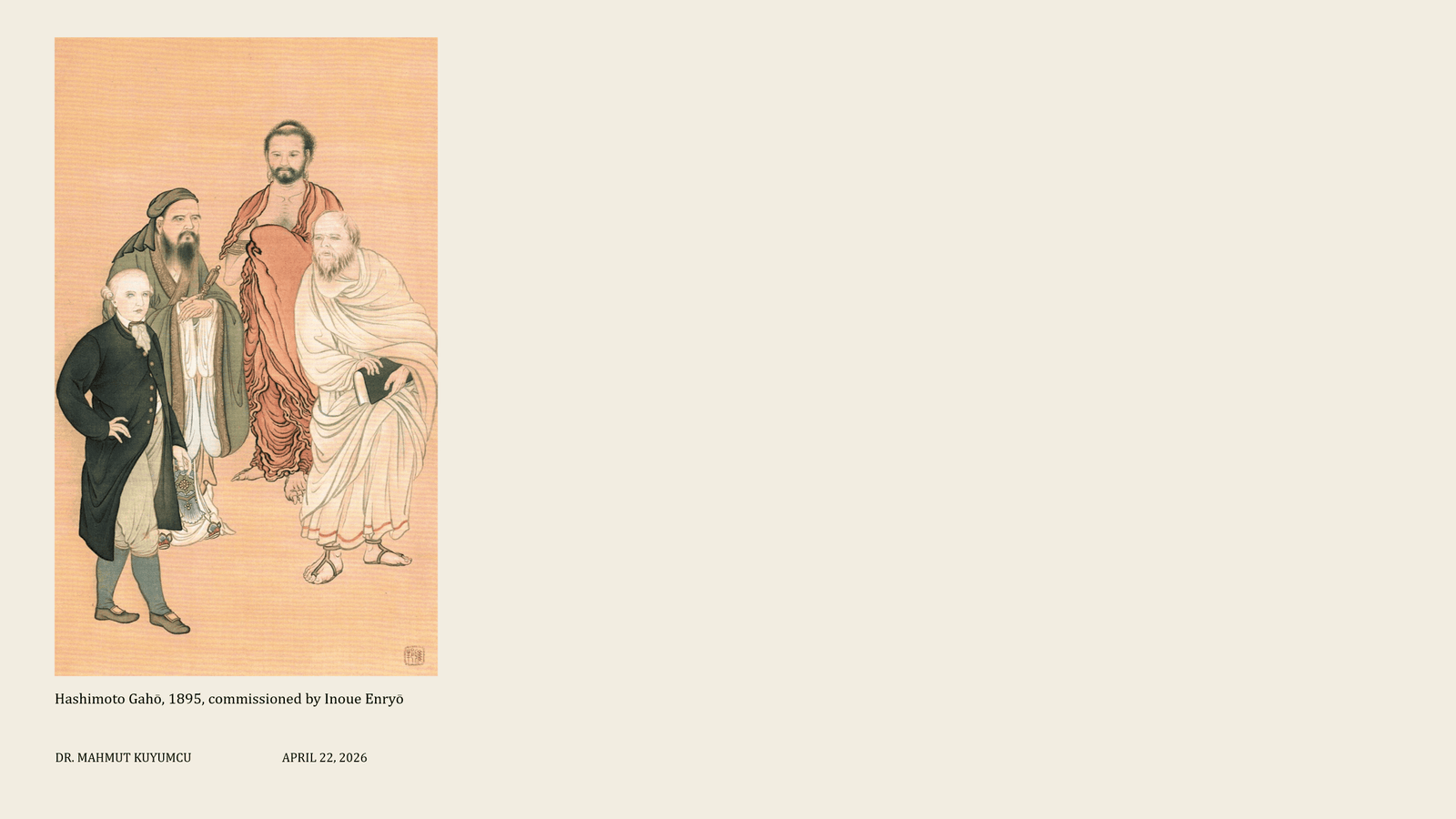
alongside a Western thinker! And all this gave my interest in Kant a new, special impetus.
Shortly after our traditional silver bean assigned me today’s task, the decision was made: surely it must be possible even for a miner to find out more about this work of art.
I have structured my remarks as follows:
- First, I outline the historical context and introduce you to the Japanese philosopher Inoue Enryō, who commissioned this picture scroll.
- Then, I outline the commonalities between these four sages.
- Finally, I recall the political-philosophical legacy of Immanuel Kant – all this in essay form.
The foundations of modern Japan were laid in the second half of the 19th century1. In 1854, Japan ended its period of almost absolute isolation, which had lasted for some 250 years. Although the immediate trigger was pressure from American warships to open the ports to trade, a movement to overcome feudal and class-based society had already formed within the country. This elite group of reformers succeeded in winning over the new Emperor Mutsuhito, who was only 15 years old, in 1868. Continuing an ancient tradition, the young Tenno gave his reign a new motto: Meiji – which translates as ‘Enlightened Rule’2.
Some eighty years earlier, Immanuel Kant had published his famous treatise ‘What is Enlightenment?’ – and now, for around half a century, Japan was governed under this new motto, undergoing fundamental political and social reforms and being led into the modern age.
Immediately after the proclamation, a government delegation1,3 of over 100 people, including five women, travelled through the USA and Europe for two years to learn about the state of the art in technology, science and the arts. At the same time, Western experts were brought to Japan. Japanologists aptly describe the subsequent reception of Western culture as a process of ‘breathtaking speed’ 4.
My remarks below are based on the book by Rainer Schulzer, ‘The Four Sages in the Garden of Philosophy’ 5,
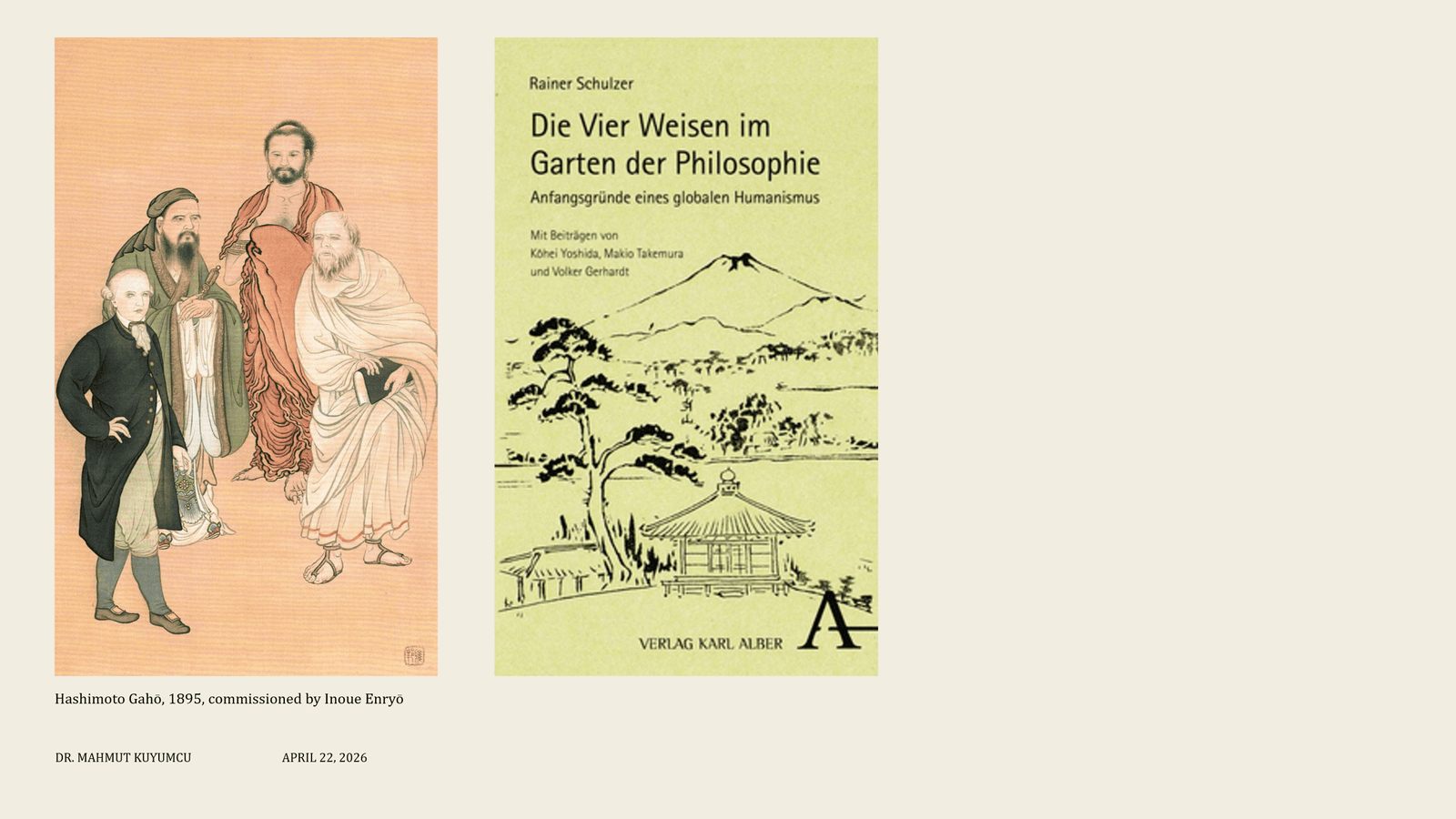
who wrote his doctoral thesis on the Japanese philosopher Inoue Enryō6.
In 1881, Inoue Enryō was
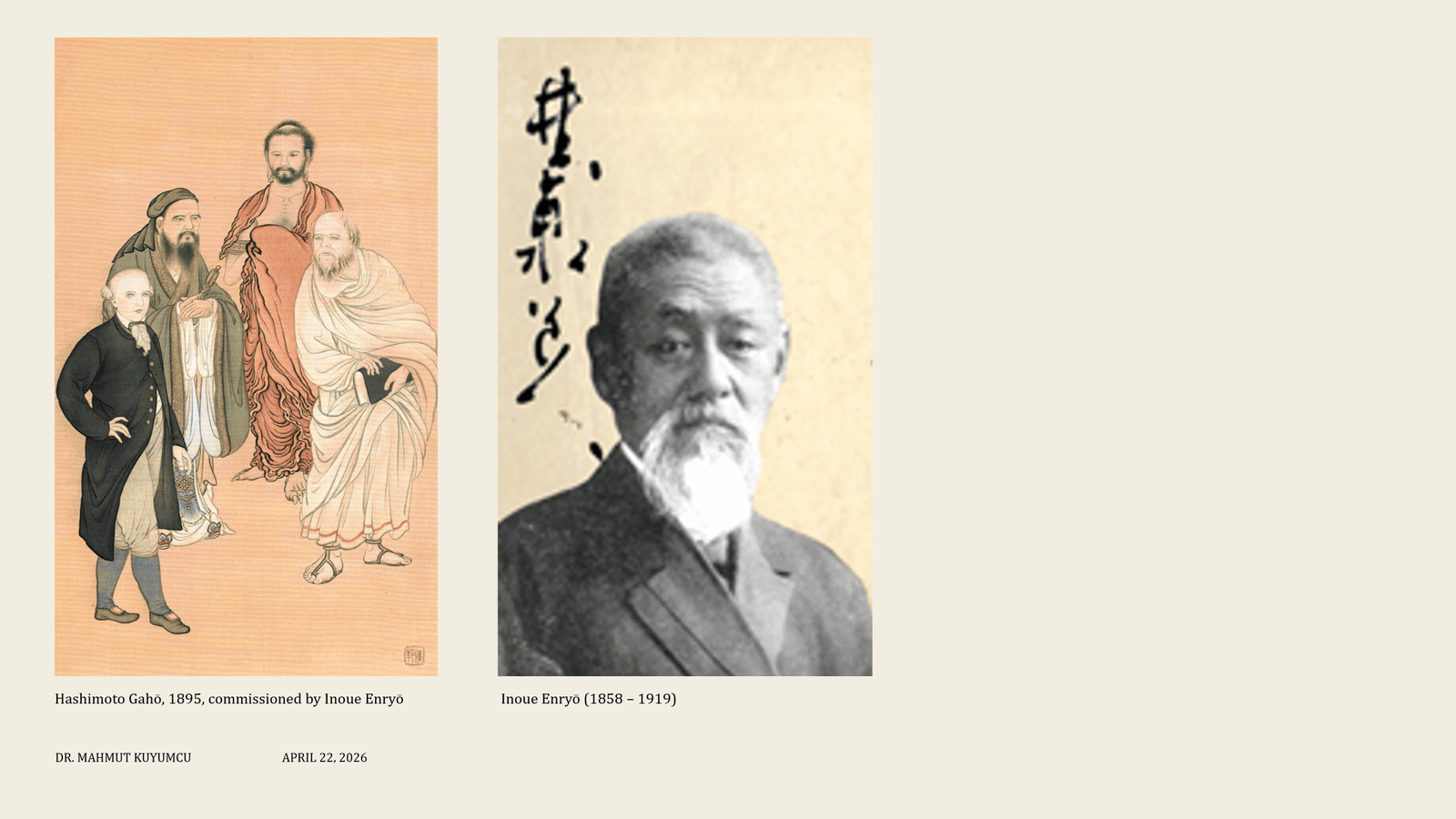
the first and only student in the newly established Department of Philosophy at the University of Tokyo, which had been founded shortly before on a Western model. His main teaching material was the English translation “An Outline of the History of Philosophy” by the German philosopher Albert Schwegler. At his own graduation in 1885, Inoue performed a philosophical ceremony during which he unrolled the picture scroll of the ‘Four World Sages’ that he had commissioned for the first time.
Inoue Enryō, who had completed his training as a Buddhist priest before studying philosophy, was not one of those who blindly adopted Western ideas. He sought, as he later said, the truth, which he had initially failed to find in Buddhism either. He was curious and arrived at his critical synthesis of modern science and the millennia-old thought of Buddhism and Confucianism. Whilst some of his contemporaries had opted for Jesus rather than Kant, he justified his choice with the following argument: these four sages derive their thinking solely from human cognitive faculties, without relying on external powers such as God or divine revelation.
Inoue Enryō founded an Academy of Philosophy, which was later transformed into Toyo University. The honouring of the Four World Sages, established at his graduation, was henceforth celebrated annually as a firm tradition at the Academy of Philosophy and later at Toyo University. From 1904 onwards, he devoted himself primarily to the construction of his ‘Garden of Philosophy’, the Tetsugakudō.
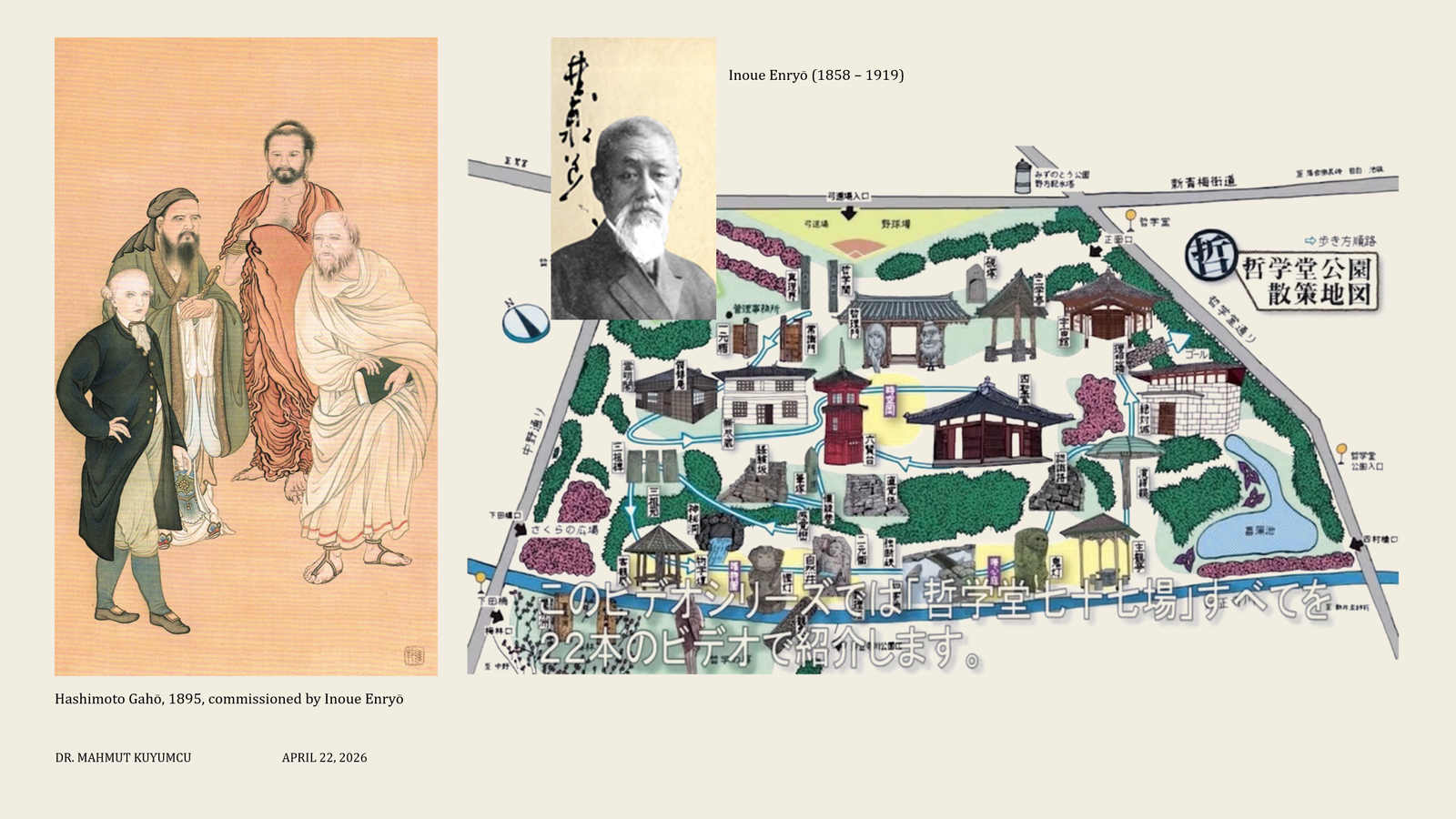
At the centre of the numerous garden architectural elements representing philosophical currents and thinkers from all over the world stands the Shrine of the Four World Sages
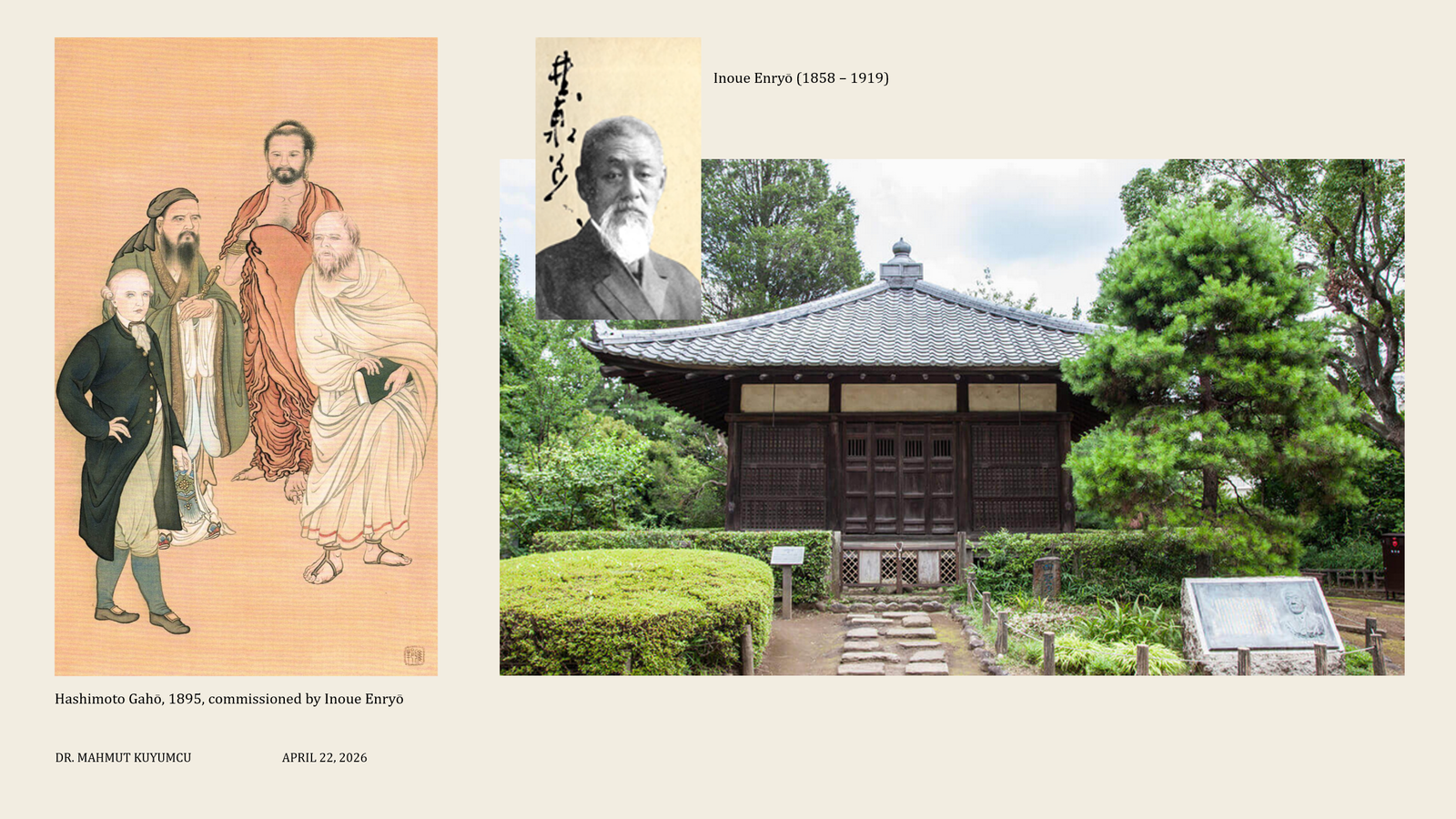
– a square hall whose walls face the four cardinal directions7.
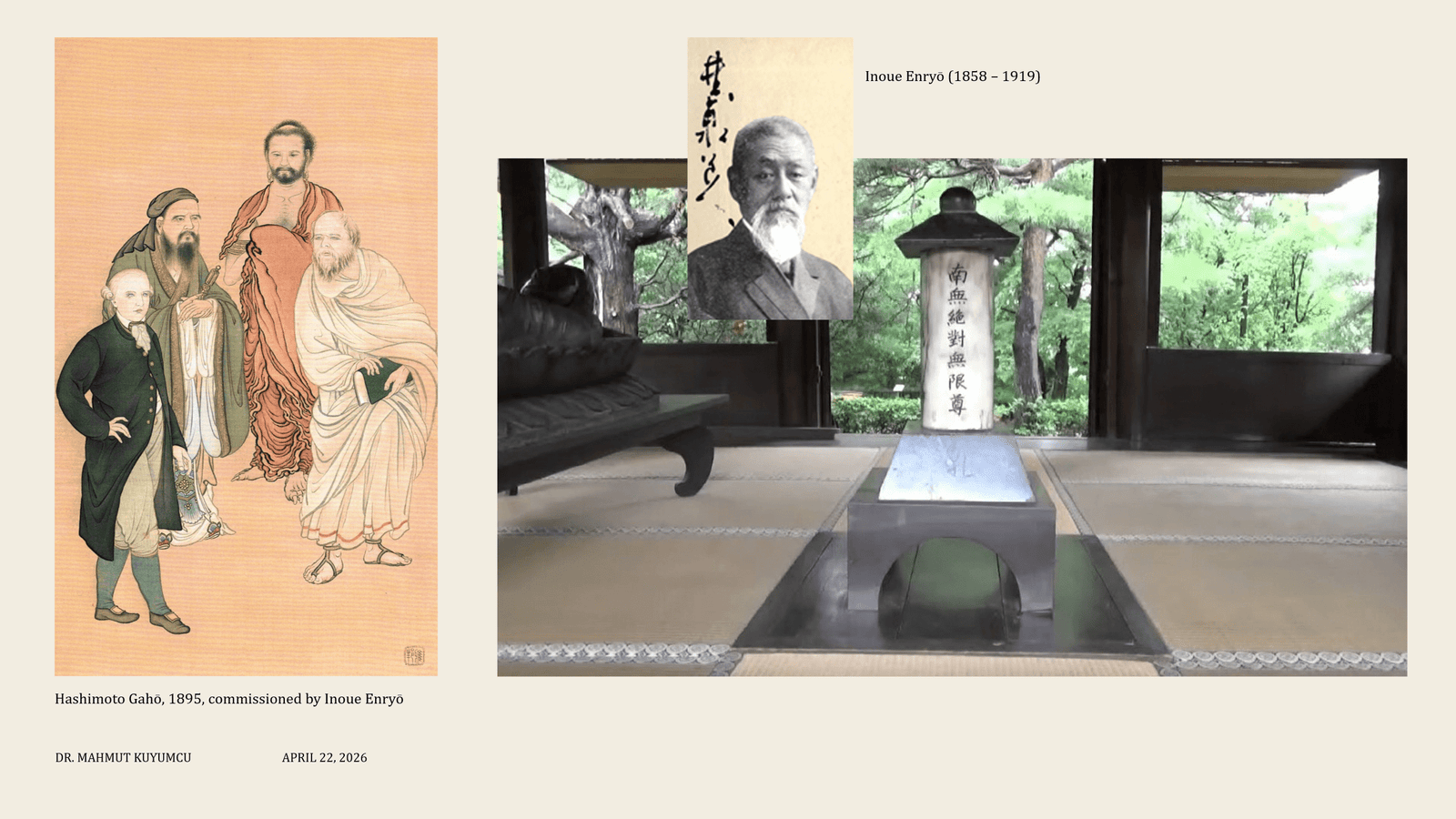
Only in the roof area are the names of the sages found on wooden plaques:
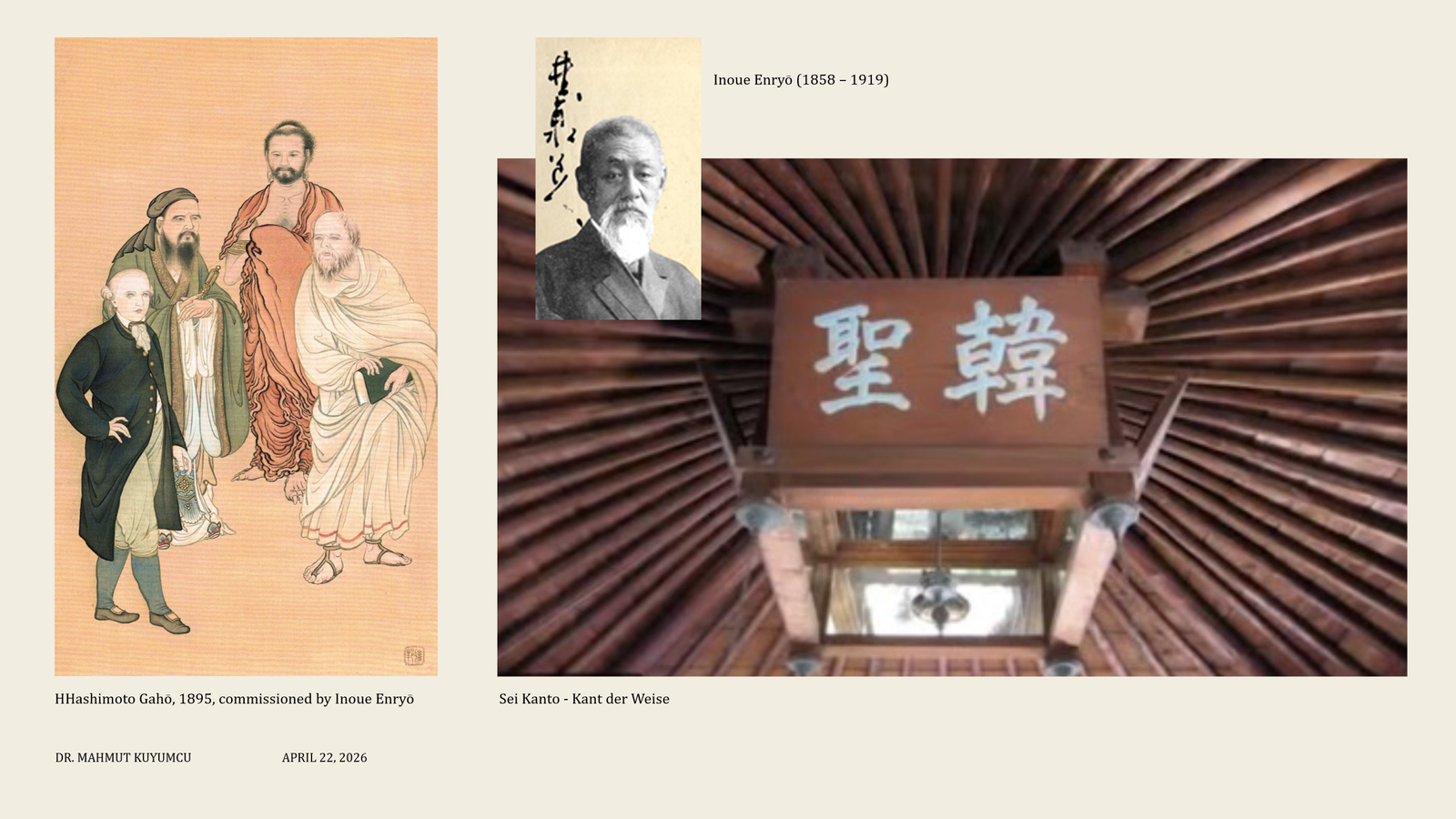
here, the signature of the ‘Kant of the Sages’ .
In accordance with Inoue Enryō’s last will, a philosophical ceremony in honour of the Four Sages is held every year at the Shrine of the Four Sages on the first Saturday in November7, and a lecture is given on a rotating basis every four years, focusing on one of the Four Sages. Next year it will be Immanuel Kant’s turn again, which is important for those planning a trip to Japan.
Inoue Enryō undertook three world tours8,
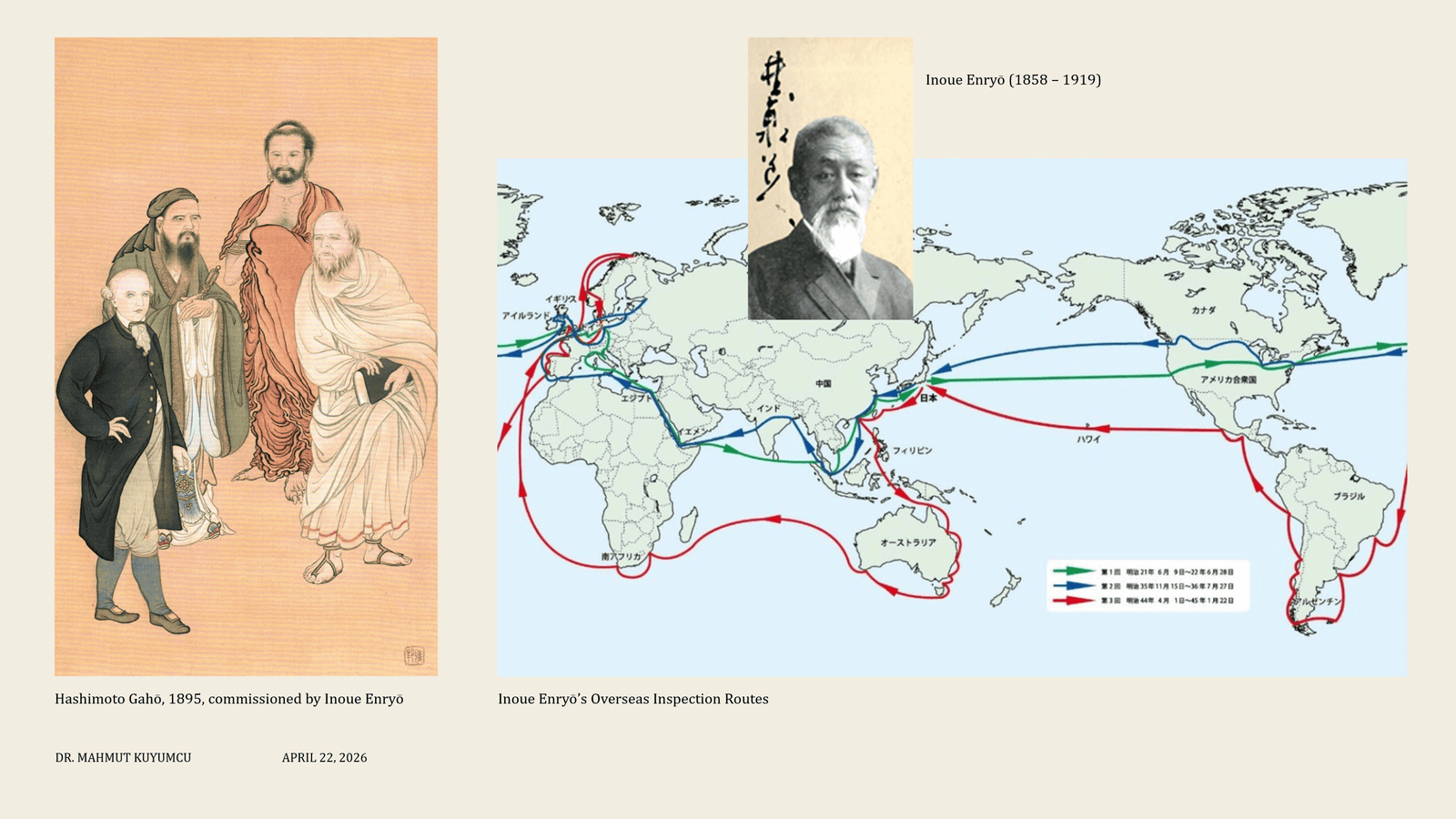
which also took him to Germany. In May 1903, he visited Königsberg9.
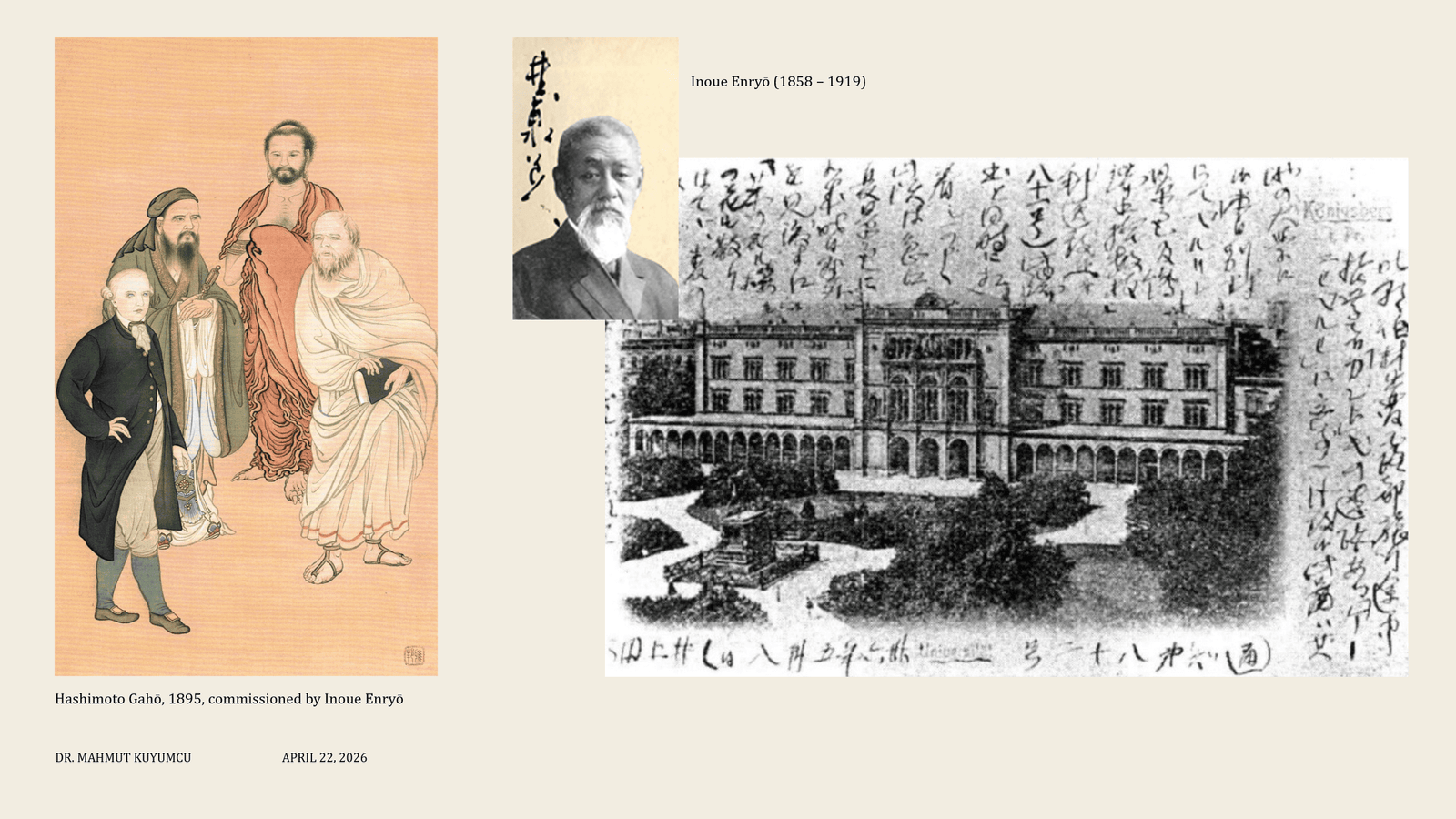
According to his notes, he held “a reverent moment of prayer before the bronze statue of Kant” in the front garden of the Königsberg Albertina and subsequently viewed Kant’s personal belongings, including his hat, walking stick, gloves and pocket mirror, etc. In the afternoon, he visited Immanuel Kant’s grave at Königsberg Cathedral and described himself as “deeply moved by a solemn sense of reverence”.
Through Inoue Enryō and his contemporaries, the reception of Western philosophy and Kant also began in China and Korea, albeit with a time lag. Much could be said about the situation in populous China. Due to time constraints, I shall confine myself to a survey by the Chinese philosopher Bo Fang, which he presented at the 13th International Kant Congress.
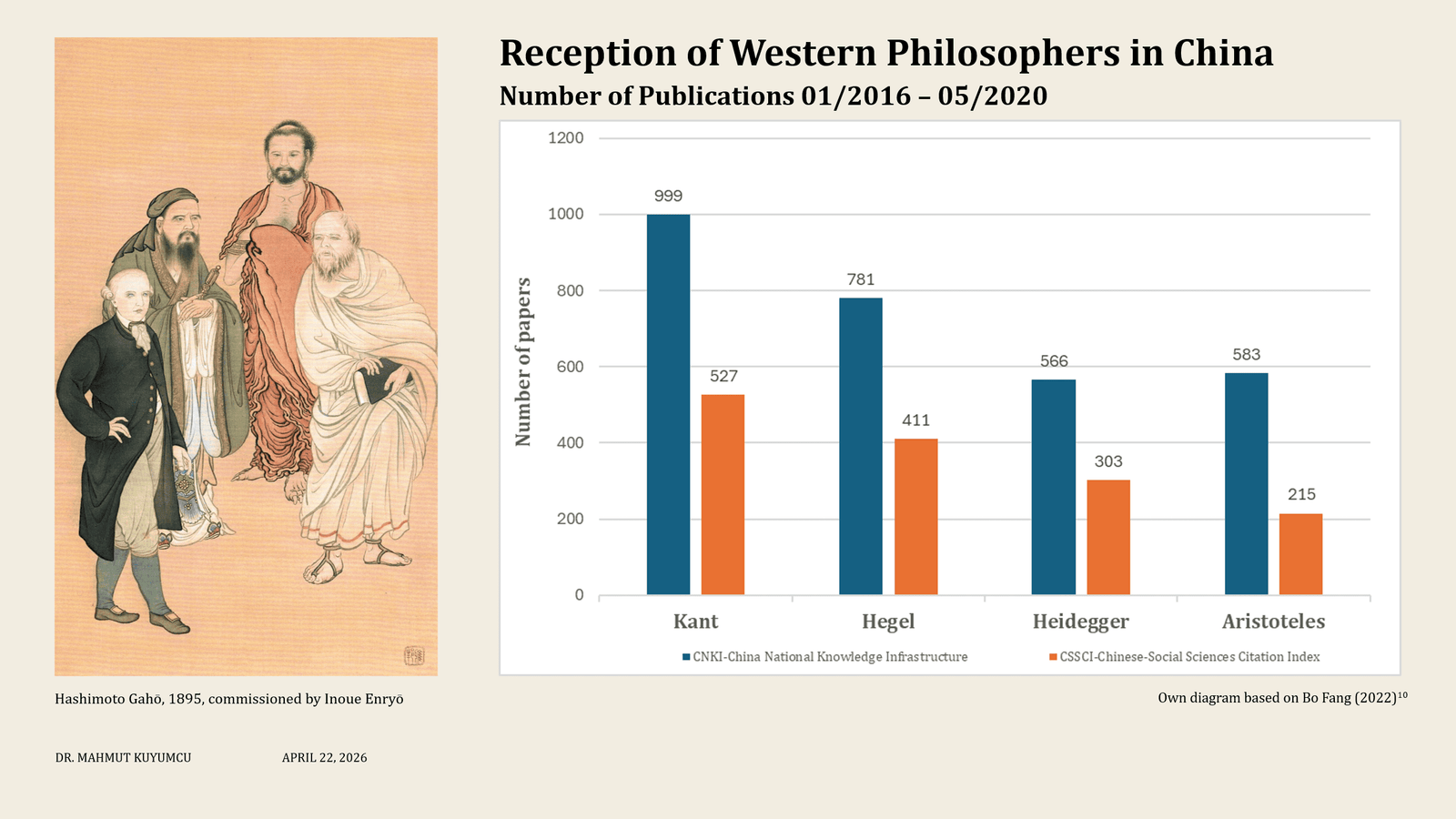
In China, Kant’s relevance is more alive than ever10,11! Here, as of 2020, is a breakdown of the number of publications whose titles feature the names of Western philosophers – excluding Karl Marx; Kant consistently ranks ahead of Hegel, Heidegger or Aristotle.
In a sense, Inoue Enryō’s illustrated scroll paved the way for world philosophy in the East. What was the situation in the West in this regard?
Although the West’s philological engagement with the East began as early as the 19th century, Eastern thought remained virtually unaccounted for in Western philosophy. Knowledge was limited to reports by Christian missionaries, primarily concerning Confucius; Buddha’s profound analyses of human nature remained largely unknown12. In 1814, Arthur Schopenhauer was the first philosopher to read the Latin translation of the Upanishads12. His admiration for Eastern wisdom was so great that he later earned the nickname ‘the Buddha of Frankfurt’13. With the works of Nietzsche and Hermann Hesse, translation activities clearly gained momentum in the 20th century12.
The Western reception of Eastern thought received a significant boost in 1957 through Karl Jaspers’ monumental work: ‘The Great Philosophers’14. For the first time, Eastern thinkers were introduced to a broad Western audience. It is noteworthy that Jaspers, too, highlighted four great thinkers as the “defining figures” of history: Socrates, Buddha, Confucius and Jesus. He classified Kant, together with Plato and Augustine, among the “perpetually creative philosophers”. With this work by Jaspers, the vision of a world philosophy also took shape in the West.
I now come to the second part of my speech: the commonalities of the four world sages5, which we can today summarise under the concept of humanism.
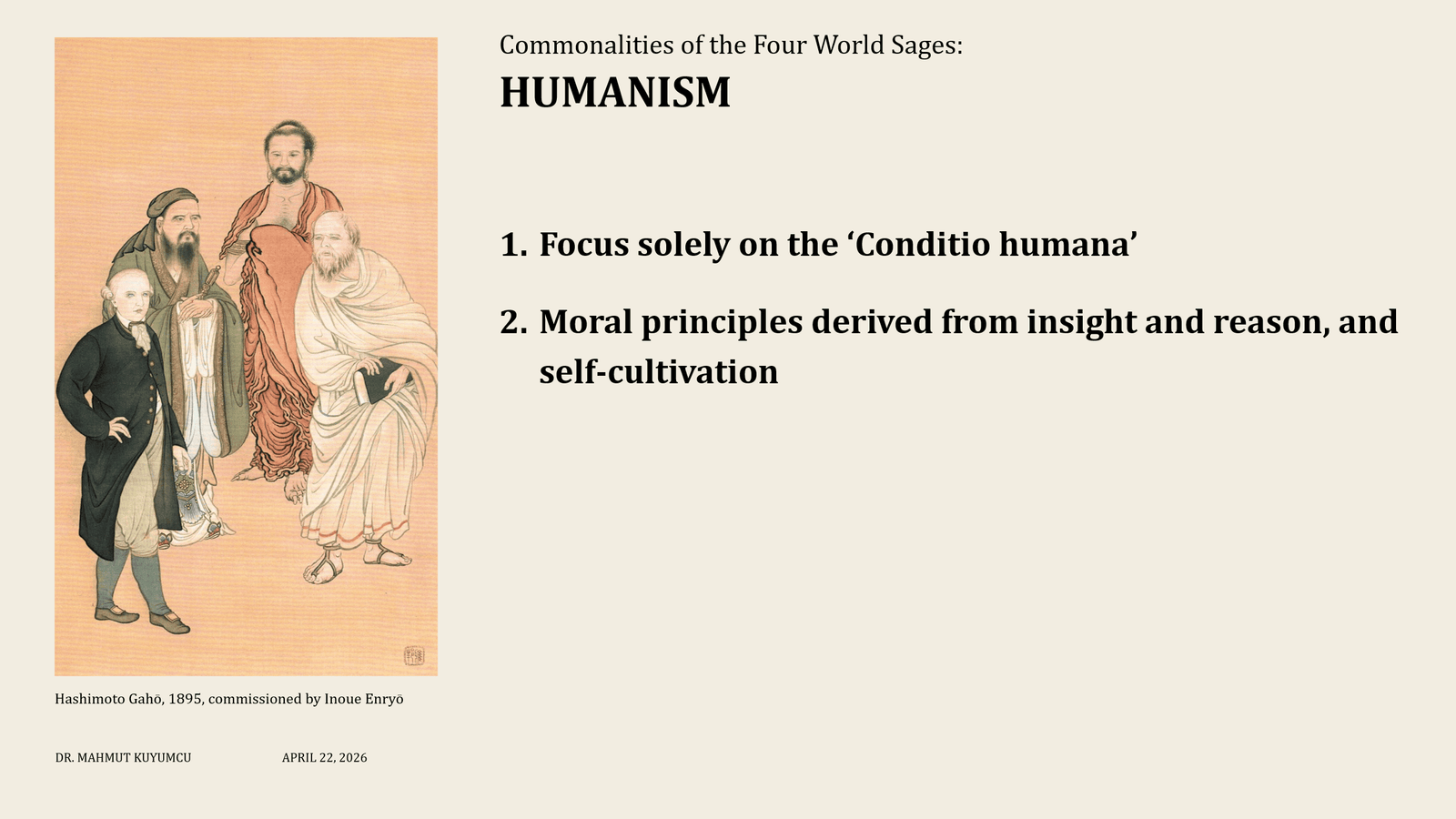
I would like to present these on the basis of their strict focus on the human condition, as well as the morality derived from the insight or reason inherent in human beings and their self-cultivation.
I shall begin with Socrates:
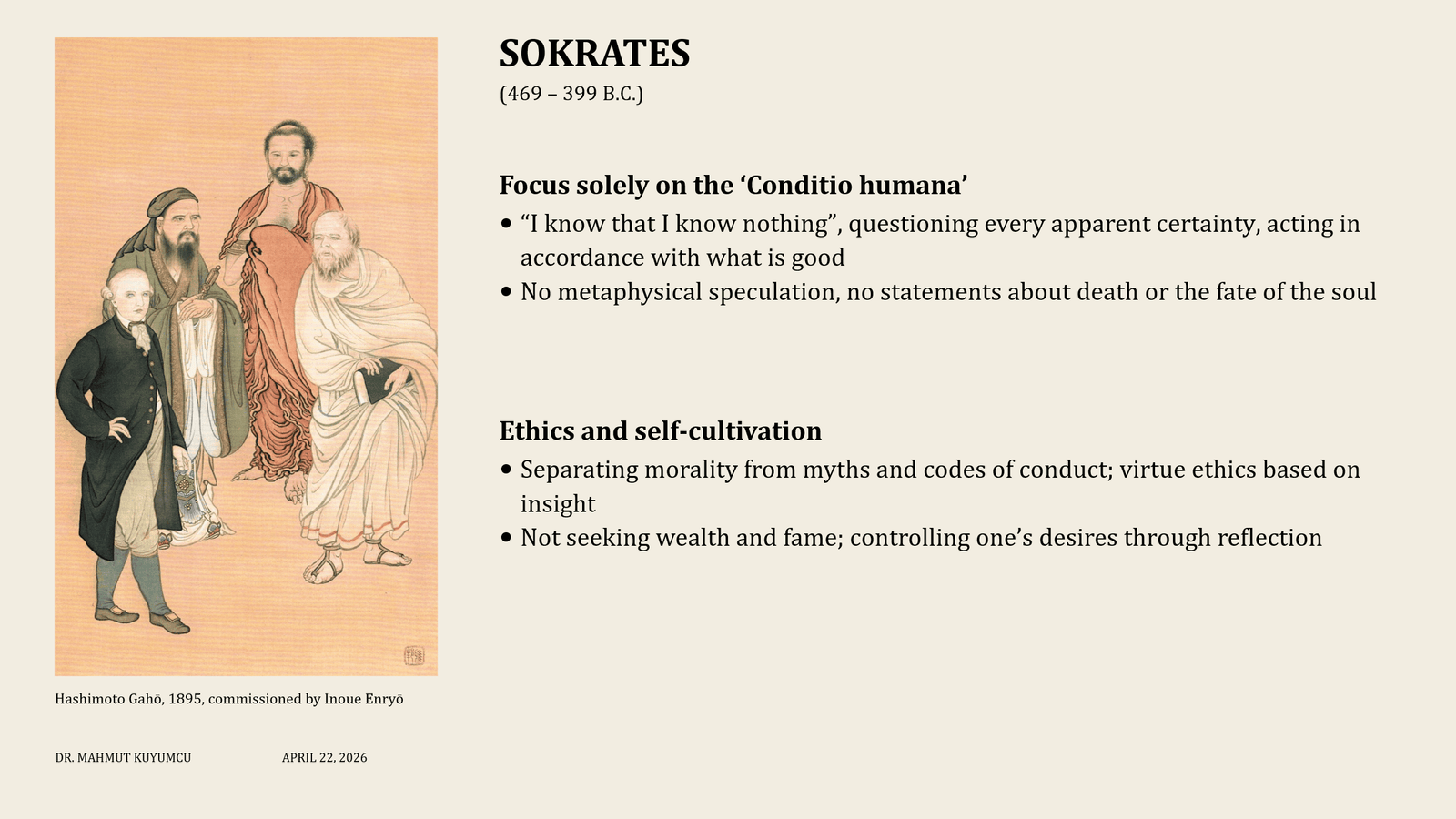
In his time, the focus of thought had already shifted from external nature to the inner self of humankind. Yet whilst his contemporaries, the Sophists, claimed that truth was relative – according to the maxim ‘Man is the measure of all things’ – Socrates sought tirelessly for the Good that is binding upon all.
His famous paradox ‘I know that I know nothing’ underpins his search for truth. He questioned every apparent certainty in order to draw closer to the truth – knowing full well that the absolutely truth remains beyond our grasp as human beings. In doing so, he laid the foundations for our critical thinking today.
He rejected metaphysical speculation and concentrated on the here and now. Even in the face of his death sentence, he remained calm and refused “to pass judgement on matters such as death or the fate of the soul, which he could not know”5.
Socrates decoupled morality from ancient myths and social conventions15: For him, right action springs solely from insight, from the Logos. This becomes clear in the dialogue ‘Laches’15: for him, courage was no longer merely, as was generally the case, the soldier’s steadfastness on the battlefield, but the civic virtue of integrity: the strength to uphold a tested conviction even against the resistance of the majority.
For Socrates, it was not wealth or fame, but the ordering of one’s own desires through insight that was the key to a successful life.
Let us turn to China’s oldest scholar16, Confucius:
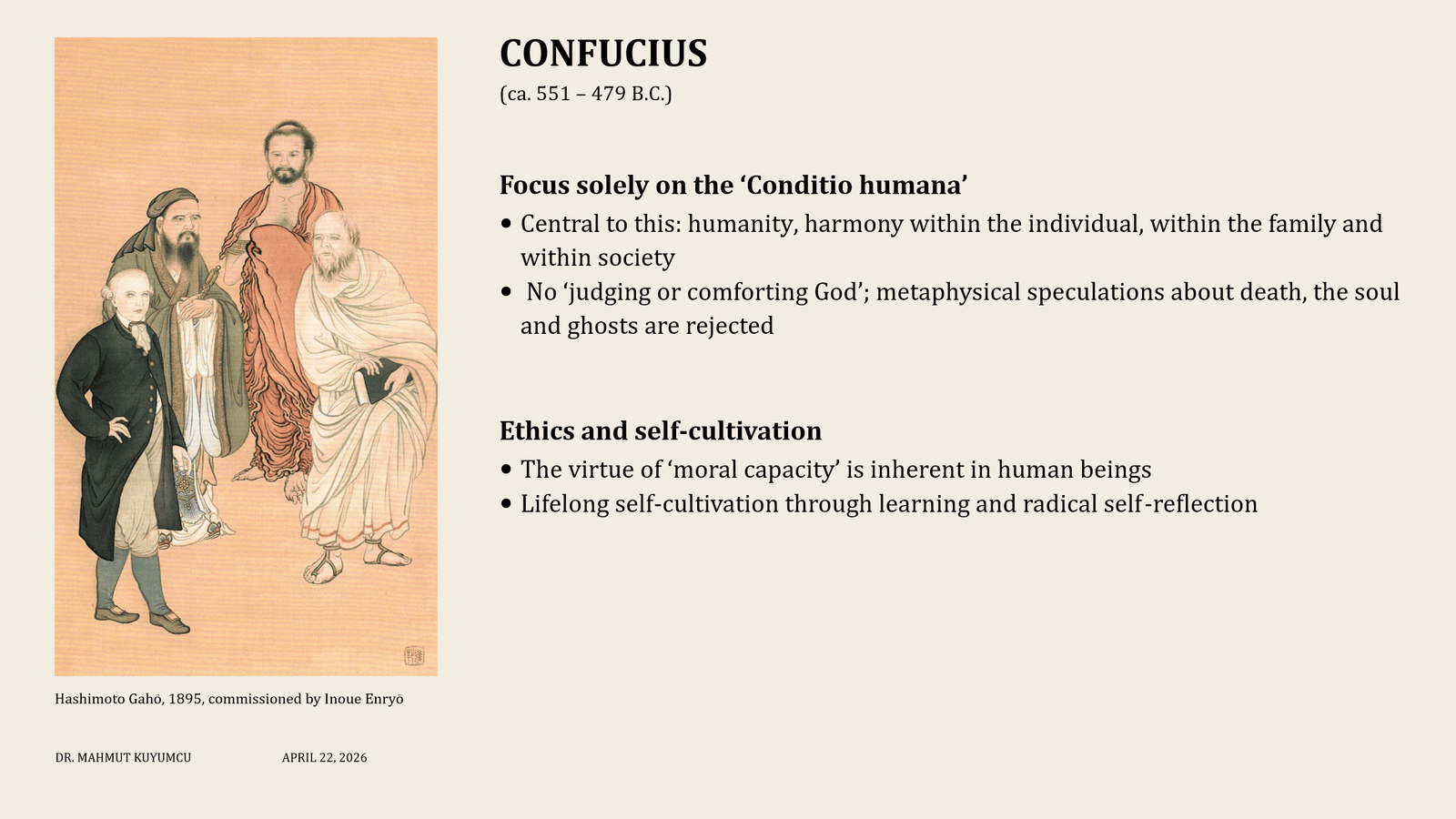
Confucius lived in an era of political and social upheaval. Shortly after his death, a long era of wars broke out, which simultaneously led to the emergence of the “Hundred Schools of Thought.” In the imperial era, his teachings were elevated to the status of state ideology and shaped the order of East Asia for two millennia. After initially being rejected as reactionary in the communist People’s Republic, they are now experiencing a remarkable renaissance as “Neo-Confucianism.”
His teachings have been handed down in the form of concisely summarized conversations with students, rulers, and others. At the centre of his thought is humanity (Rén) – humaneness17. His aim was to foster harmony: within the individual, within the family, and within society.
A judging or consoling God has no place in his system17: Metaphysical speculations are rejected: When asked by a student about death, he replied succinctly: “I do not yet know life. How could I provide information about death?”
Confucian ethics is based entirely on the moral capacity of human beings, virtue (dé). The path to this is lifelong self-cultivation through learning and radical self-reflection. One of his most famous quotes sums up this view: “Learning and constantly practicing what has been learned—is that not happiness?”
For Confucius, the human being is not a finished being, but a task at which one must work daily17.
Now a brief look at the third member of the Four Sages: Buddha.
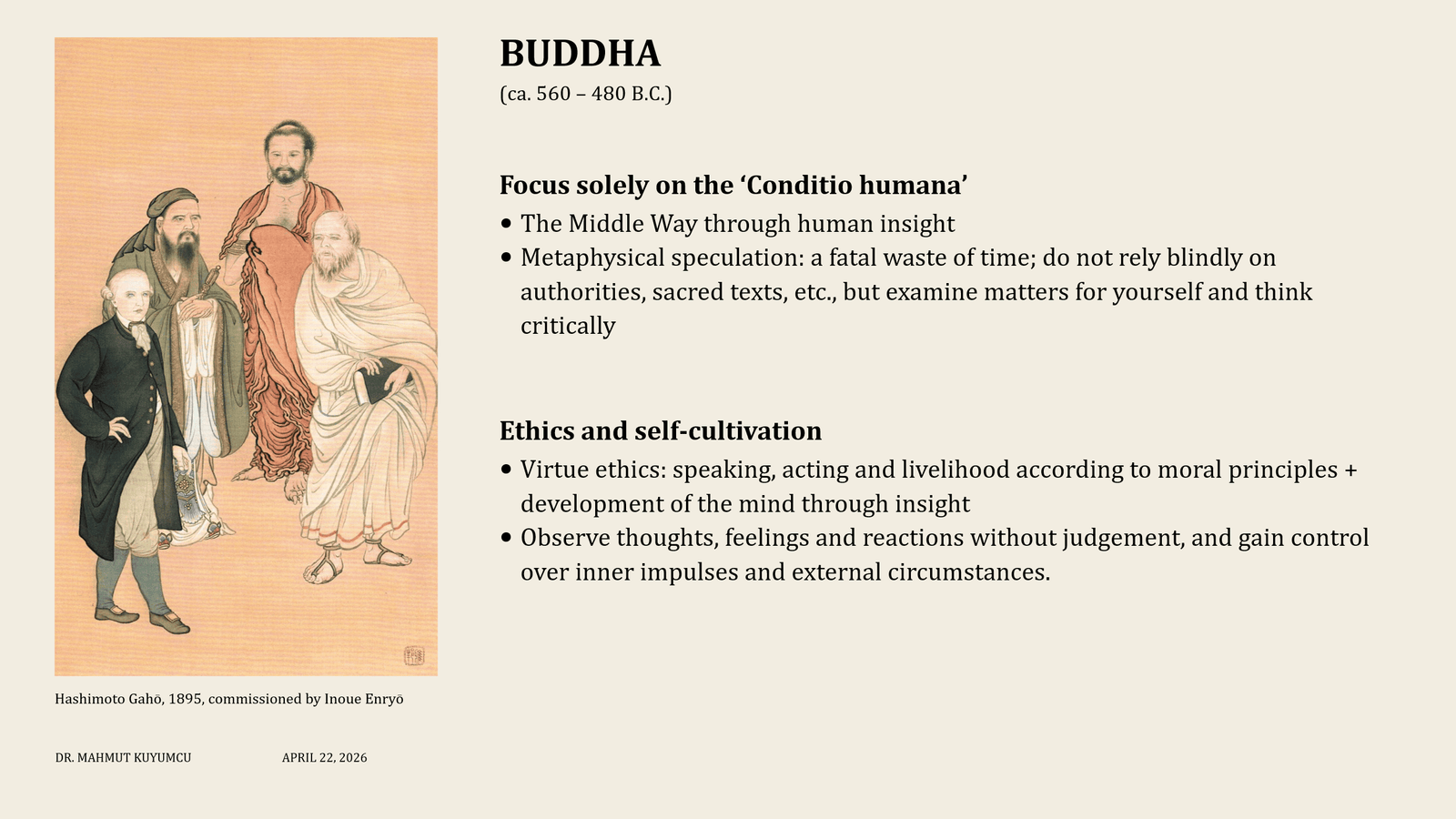
During Buddha’s lifetime, India was undergoing a massive intellectual and cultural upheaval. Numerous schools of thought18 had emerged in opposition to rigid religious Brahmanism and its caste system—ranging from materialism and nihilism to radical asceticism. Siddhartha Gautama, the future Buddha, saw the answer to life’s existential questions solely in human insight and chose “the Middle Way.”
He rejected metaphysical speculation as a fatal waste of time19,20. He compared a disciple who wanted to know whether the universe was infinite or the soul immortal to a man who had been struck by a poisoned arrow and refused to have the arrow removed and the wound treated until he knew exactly who had shot it, which caste the archer belonged to, and what kind of wood the arrow was carved from.
He advised against blindly relying on the authority of sacred texts or traditions21. Instead, he said, each person should examine for themselves what is wholesome or unwholesome for them and others. According to the Buddha, every person possesses the potential to do this within themselves.
Buddha analysed existence like a doctor and made his diagnosis: everything that exists is impermanent. Clinging to what is desired, resisting what is undesired, and ignorance of this nature of things lead people into constant dissatisfaction—into suffering. Yet it is precisely this insight that is also the key to healing.
His ethics of virtue (Sila) is based on three pillars22: conducting speech, action, and livelihood in a moral manner—specifically: not lying, not stealing, and not harming others. In this way, a person builds an inner protective wall to create the necessary calm for the development of the mind.
The mind must then be cultivated: thoughts, feelings, and reactions should be observed without judgment, without identifying with them. Over time, people thus gradually attain the freedom to act independently of inner impulses and external circumstances.
We now come to the fourth sage: Immanuel Kant.
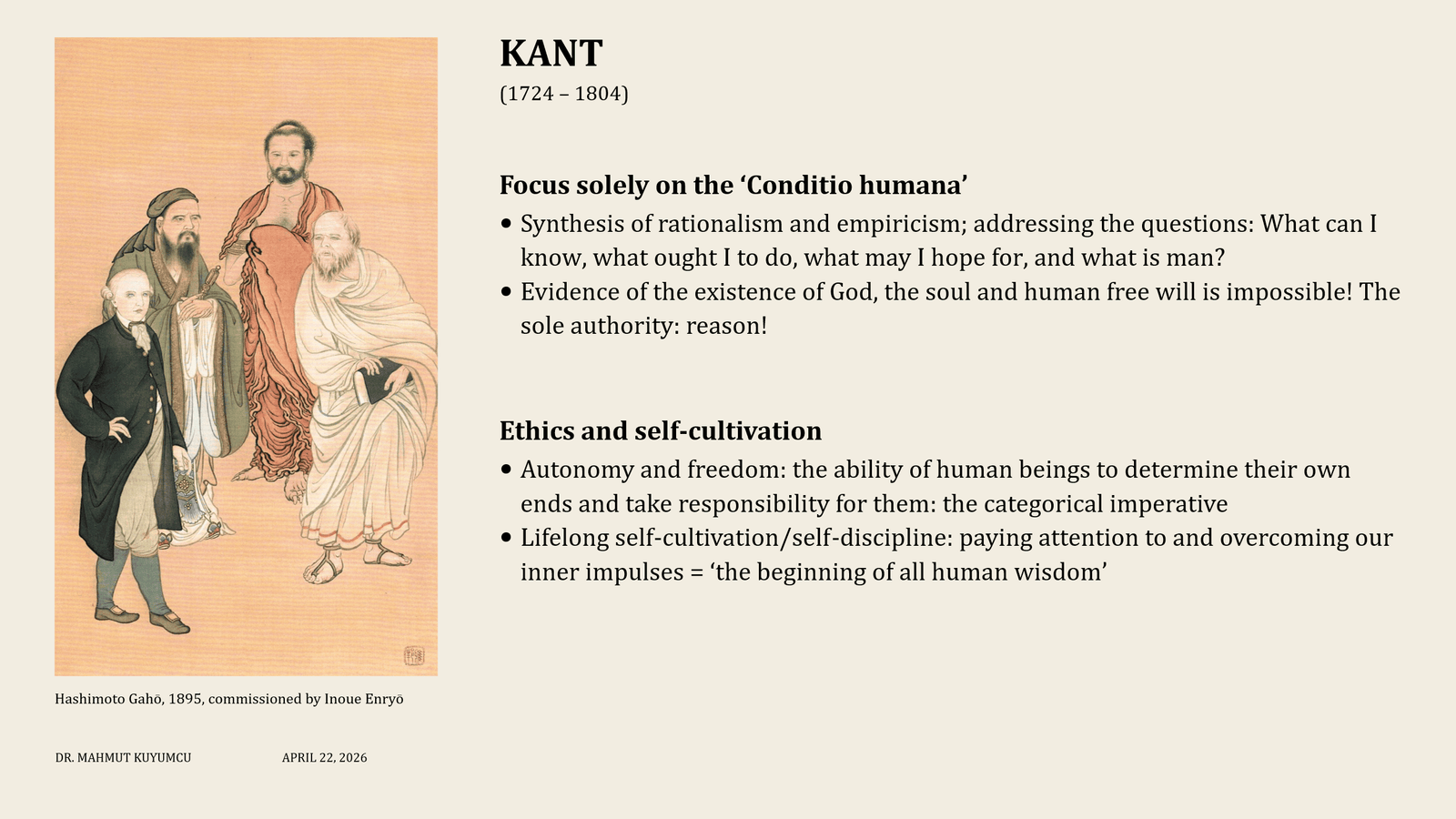
In Kant’s time, a debate that had been raging in philosophy for two centuries was raging over the true source of knowledge—namely, the question: Does it lie solely in reason or in empiricism? Kant resolved this dispute by radically tracing thought back to human beings themselves, thereby uniting both schools of thought. He also addressed humanity’s fundamental existential questions. He distilled them into those four world-famous core questions that still form the coordinate system of philosophy today: What can I know? What should I do? What may I hope for? – and finally: What is man?
In his Critique of Pure Reason, he demonstrated with the highest theoretical rigor that no scientific statements can be made regarding the existence of God, the immortality of the soul, or the problem of absolute human freedom23. According to Kant, the reason inherent in human beings is the sole authority for our thinking and action.
From this autonomy of reason arises human freedom to determine one’s own ends and to take responsibility for one’s actions24. With his Categorical Imperative – “Act only according to that maxim through which you can at the same time will that it should become a general law” – he laid the moral foundation for a modern society of free and equal citizens.
Even though his deontological ethics differs formally—that is, in its purely logical examination—from ancient virtue ethics, the four Sages converge again at the core of moral and social self-responsibility.
For Kant, too, self-cultivation—in the sense of the time, a continuous “self-moralization”—is indispensable. He urges us to always heed our innate impulses and “to reach into the depths of the heart that are difficult to fathom”25,26, in order to remain vigilant against that “evil will lurking within us.” For Kant, it is precisely this honest, often painful awareness of one’s own imperfection that is the “beginning of all human wisdom”26.
Ladies and gentlemen,
In closing, I would like to briefly recall Kant’s political legacy: his philosophical treatise Perpetual Peace28.
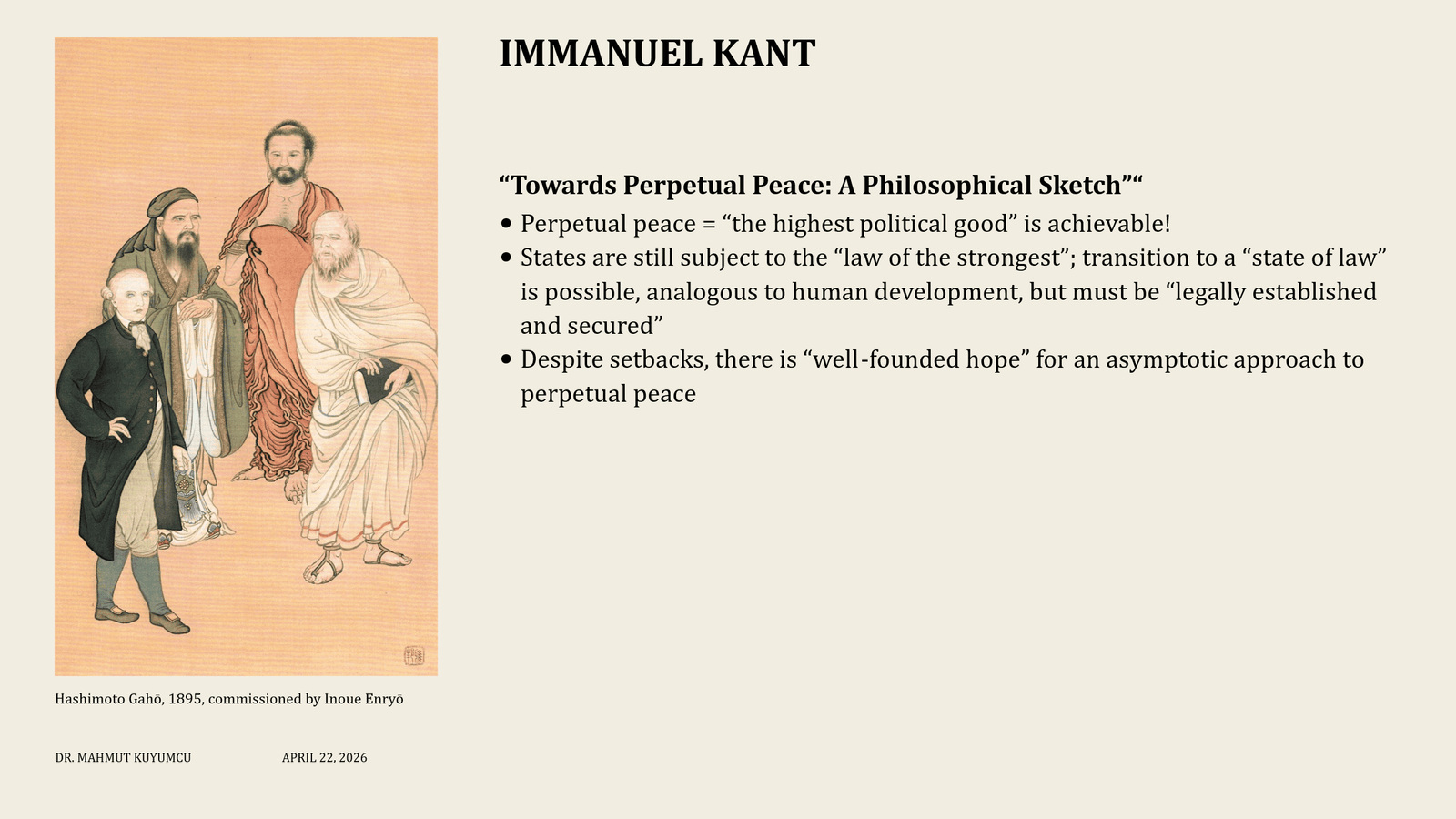
Even the ancient sages, in their conversations with rulers, reminded them of their special responsibility for nonviolence and peaceful coexistence.
Over the following two millennia, states and empires rose and fell, always accompanied by wars that brought suffering and hardship to the population—as was also the case in Kant’s time. Spurred by the rapid development of science and technology in his era, the Enlightenment raised the question of whether this would not lead to a steady progress of humanity toward the better. There were clear statements on this, both affirmative and negative.
In his 1784 paper “Idea for a Universal History from a Cosmopolitan Point of View”27, Kant analysed human nature in depth. He identified in humans a “unsociable sociability.” On the one hand, we are “carved from such crooked wood”, since we act against one another driven by “ambition, lust for power, or greed”; at the same time, however, we possess the insight that cooperation is advantageous. Through the interplay of these two poles, humanity has ultimately evolved from the “law of the strongest” to the “state of law” within a state. Although states still find themselves in a “law of the strongest” situation, they have the analogous possibility of freeing themselves from “the state of the strongest.”
Kant expanded on this approach in his 1795 work *Perpetual Peace*. He first made it clear that the mere absence of war is not yet peace, but only a ceasefire. He saw the possibility of true peace as arising from a lasting legal order, described this as the “highest political good,” and defined the legal framework for it: specifically, a federative union of states in which the citizens themselves decide on their constitution, as well as on war and peace. From then on, the same moral principles should apply between these states as between free individuals: fidelity to treaties, non-interference in internal affairs, and the renunciation of violence. Kant understood perpetual peace neither as an empty utopia nor as a gift of history, but as an ongoing task of reason. Despite constant setbacks, the ‘well-founded hope’ of an endless progression toward this goal remains. As evidence of this unstoppable progress of freedom, he pointed to the French Revolution29: Despite all its horrors, it brought an enthusiasm into the world that—according to Kant—can never be forgotten.
The League of Nations of 1920 and the United Nations of 1945 were at least partially guided by his writings. At present, however, we are witnessing a renaissance of the “law of the strongest.” Thus, the question is once again highly topical: Where did the sages of the world—Socrates, Confucius, Buddha, and Kant—derive the conviction that moral progress can truly be achieved despite all setbacks?
Kant described the source of his confidence at the end of his “Critique of Practical Reason” with those unforgettable words30:
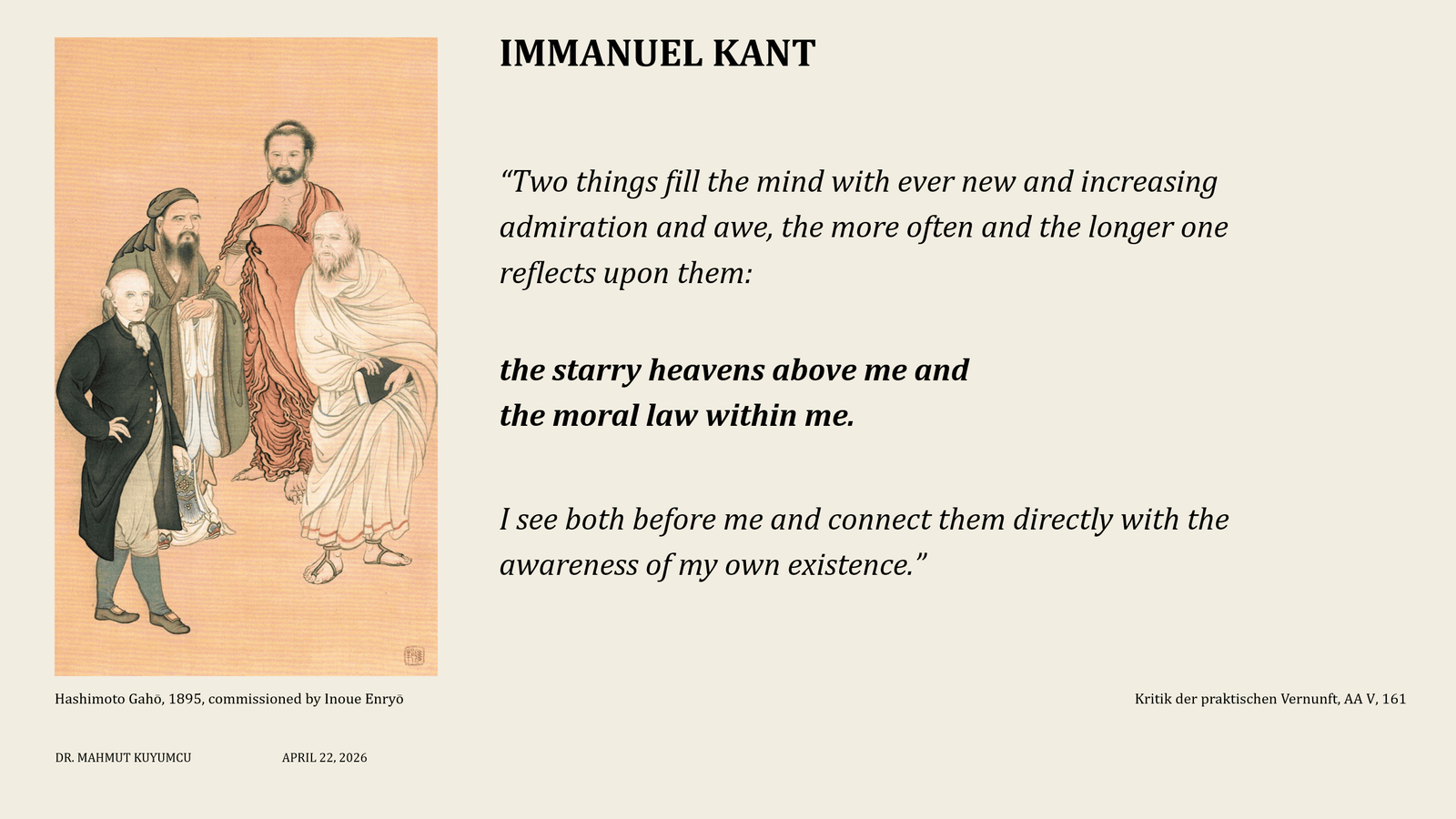
“Two things fill the mind with ever new and increasing admiration and awe, the more often and the longer one reflects upon them:
The starry heavens above me and the moral law within me.
I see both before me and connect them directly with the awareness of my existence.”
In this spirit, I wish us all many more coivial hours in honour of our birthday boy, and I thank you all very warmly for your attention and your patience!
Quellennachweis
1. Schwentker, Wolfgang. (2022). Geschichte Japans. C.H.Beck Verlag.
2. Toyohara Kunichika (1835-1900). 2006. Eine Untersuchung seiner Meiji-zeitlichen Farbholzschnitte unter besonderer Betrachtung der Rezeption von bunmei kaika (Zivilisation und Aufklärung), Dissertation, Philosophischen Fakultät der Rheinischen Friedrich-Wilhelms-Universität zu Bonn, S. 35
3. Iwakura Mission: https://www.jacar.go.jp/english/exhibition/iwakura_en/person/index.html
4. Elberfeld, Rolf. (2004). Philosophie in Japan – Japanische Philosophie. Perspektiven der Philosophiegeschichtsschreibung im 20. Jahrhundert, in: Polylog. Zeitschrift für interkulturelles Philosophieren, 10/11:2004, S.53
5. Schulzer, Rainer. (2023). Die Vier Weisen im Garten der Philosophie, Anfangsgründe eines globalen Humanismus.Verlag Karl Alber
6. Schulzer, Rainer. (2018). Inoue Enryo: A Philosophical Portrait. State University of New York Press, Albany
7. Webseite Garten der Philosophie-Tetsugakudo: https://www.tetsugakudo.jp/en/movie2/enmovie5.html, 19.02.2026
8. Takemura, Makio. (2012). The Life of Inoue Enryo, Toyo University History Booklet -1: https://www.google.com/search?q=Toyo+University+History+Booklet+1
9. Reisenotizen Inoue_u.a. zu Königsberg/Übersetzung.pdf
10. Bo, Fang (2022). Enlightenment and the Historical Dimension of Public Reason. In De Gruyter, THE COURT OF REASON, Proceedings of the 13th International Kant Congress (1335-1343).De Gruyter.
11. Zhao Tingyang. (2021). Alles unter dem Himmel. Vergangenheit und Zukunft der Weltordnung. Suhrkamp Verlag
12. Sebastian Gäb. Reception Buddhismus im Westen: https://www.youtube.com/watch?v=2d4J_BCEY4E, 19.02.2026
13. Schubbe D., Koßler M. (Hg.). Schopenhauer Handbuch, Leben – Werk – Wirkung, J.B. Metzler Verlag, 2. Auflage, S. 11. (1864b1d96cf1ea09ffff800cfffffff0.pdf)
14. Jaspers, Karl. (2007). Die großen Philosophen. Hohe Verlag
15. Gerhardt, Volker (2023). Das epochale Exempel des Sokrates. In: Schulzer, Rainer. (2023). Die Vier Weisen im Garten der Philosophie, Anfangsgründe eines globalen Humanismus. Verlag Karl Alber, S. 129-130
16. Sebastian Gäb. Konfuzius: https://www.youtube.com/watch?v=9dgUia5a86E
17. Yoshida Kohei. (2023). Die Welt der konfuzianischen Gespräche. In: Schulzer, Rainer. (2023). Die Vier Weisen im Garten der Philosophie, Anfangsgründe eines globalen Humanismus. Verlag Karl Alber, S. 99-11
18. Sebastian Gäb. Buddha: https://www.youtube.com/playlist?list=PLUAKT2TAMtbEwWcPDh1e0RyeHtrowDxyA
19. Schulzer, Rainer. (2023). Die Vier Weisen im Garten der Philosophie, Anfangsgründe eines globalen Humanismus.Verlag Karl Alber, S. 27
20. Bhikkhu, Bodhi. (2008). In den Worten des Buddha, mit einem Vorwort des Dalai Lama. Verlag Beyerlein Steinschulte. S. 216-219, MN 63
21. Bhikkhu, Bodhi. (2008). In den Worten des Buddha, mit einem Vorwort des Dalai Lama. Verlag Beyerlein Steinschulte. S. 82-85, AN 3:65
22. Bhikkhu, Bodhi. (2008). In den Worten des Buddha, mit einem Vorwort des Dalai Lama. Verlag Beyerlein Steinschulte. S. 211, 224-225 SN 45:8
23. Schulzer, Rainer. (2023). Die Vier Weisen im Garten der Philosophie, Anfangsgründe eines globalen Humanismus.Verlag Karl Alber, S. 27
24. Kant, AA V, 8ff
25. Elberfeld, Rolf. (2013). Kants Tugendlehre und buddhistische Übung: Auf dem Weg zu einer kulturoffenen und kritischen Kultivierungspraxis, in: Dimensionen der Selbstkultivierung: Beiträge des Forums für Asiatische Philosophie, hg. v. Marcus Schmücker u. Fabian Heubel, Freiburg/München: Alber, 2013, 27-63.
26. Kant, AA VI, 441
27. Kant, AA VIII,S. 15-31
28. Kant, AA VIII,S. 341-386
29. Kant, AA VII, 79-94
30. Kant, AA V, 161