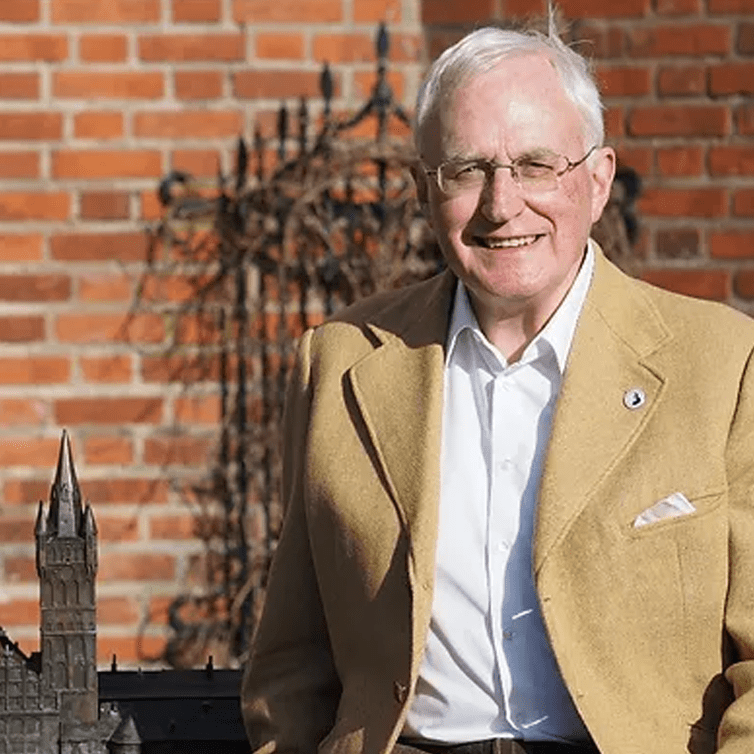

You are cordially invited to the launch of PEACE AND WAR OVER KÖNIGSBERG by Gerfried Horst.
Please join us on Wednesday 23rd October from 6.30pm to 9.00pm in the Strangers Room at the Reform Club, 104 Pall Mall, London SW1Y 5EW.
Dress code: Jacket, but no tie, required. No jeans or trainers.
RSVP: Either to Gerfried Horst (gerfried.horst@freunde-kants.com) or Richard Constant (richardconstant3@gmail.com).

Immanuel Kant, arguably the greatest philosopher since Plato, was born in Königsberg in Prussia on 22 April 1724, studied and taught at the local University “Albertina”, published his major work “Critique of Pure Reason” in 1781 and died in his hometown on 12 February 1804. Immanuel Kant is so identified with Königsberg that it was called “The Capital of Philosophy,” and “The City of Pure Reason.”
As early as the second half of the thirteenth century, English merchants travelled to East Prussia. The thirteenth and fourteenth centuries saw the emergence of the Baltic Crusades, aimed at Christianising the Prussians and Lithuanians. One of the most famous of the Crusaders was Henry of Bolingbroke, Earl of Derby (later Henry IV of England, 1399-1413). A large migration of Scots to Prussia and the Baltic countries continued through the sixteenth and seventeenth centuries. Kant’s best friends, Joseph Green and Robert Motherby, were Englishmen having migrated to Königsberg from Hull.
It is ironic that Königsberg whose history from its foundation was always closely related to England was in the end destroyed by British bombs. After a first attack on 26th August 1944 by the Royal Air Force, a second attack on 29th August 1944 caused a firestorm, burning down the historic central part of Königsberg including the castle, the university buildings, the cathedral where Kant was baptized and buried, and many other churches and old buildings. About 6,000 of Kant’s fellow countrymen, mostly women, children and old people, died.
The destruction of Königsberg was, of course, not an isolated event but part of the British strategy to win the War. Gerfried Horst’s book tells of the origins and history of that strategy through the lens of Königsberg. It was the British who developed and implemented area bombing of civilian populations to eliminate, by the destruction of morale and the killing of civilians, the means of production. The book demonstrates that this strategy continued after it was clear that the war was being won by the Allies and even after it was clear that the strategy didn’t work, to a point when night after night in the final year of the War German cities were being reduced to rubble and their inhabitants killed.
But Königsberg’s significance goes beyond that. The old city no longer exists. The easternmost German major city became the westernmost Russian major city. But Königsberg, also under its Russian name of Kaliningrad, remains Immanuel Kant’s hometown, the place where Kant in 1795 published his Philosophical Project: Toward Perpetual Peace.
On 22 April 2024 Kant’s 300th birthday was celebrated in Germany, in Russia, in Poland, in England and in many other countries of the world. 29th August 2024 will see the 80th anniversary of the destruction of Kant’s hometown.
At the time of writing this, it is not clear how the war between Russia and Ukraine will end. Kant’s Philosophical Project: Toward Perpetual Peace contains some practical advice about how this could be achieved. Gerfried Horst’s book shows Königsberg’s history as a part of world history and an example of the practical relevance of Kant’s philosophy.